Use AI Assistants Without Outsourcing Your Judgment

The weirdest thing about a good AI assistant is how quickly it starts to feel right.
It writes in full sentences. It sounds calm. It gives you a numbered list, because apparently the machine also went to management-consultant finishing school. It can summarize a mess, draft the awkward email, turn notes into structure, and explain the thing you were pretending to understand in the meeting.
That is useful.
It is also the trap.
Fluent output is not proof. A confident answer is not a source. A tidy paragraph is not a decision. An AI assistant can be genuinely helpful and still be wrong, stale, generic, biased, or missing the one piece of context that changes everything.
The point is not to stop using the tool. The point is to stop treating the tool like an authority.
Use AI assistants for leverage, not permission.
The assistant is not the boss
An AI assistant is best understood as a fast helper with no actual stake in the outcome.
It can brainstorm options when you are stuck. It can turn a wall of notes into a clean outline. It can explain a concept three different ways. It can draft, compare, summarize, translate, organize, and pressure-test. It can give you something to react to instead of staring at the cursor like the cursor owes you money.
But it does not know what matters unless you tell it.
It does not automatically know your audience, your constraints, your private boundaries, your taste, your source material, or which claim would get you in trouble if it were wrong. If you give it a vague job, it will often give you a plausible answer. Plausible is where the gremlins live.
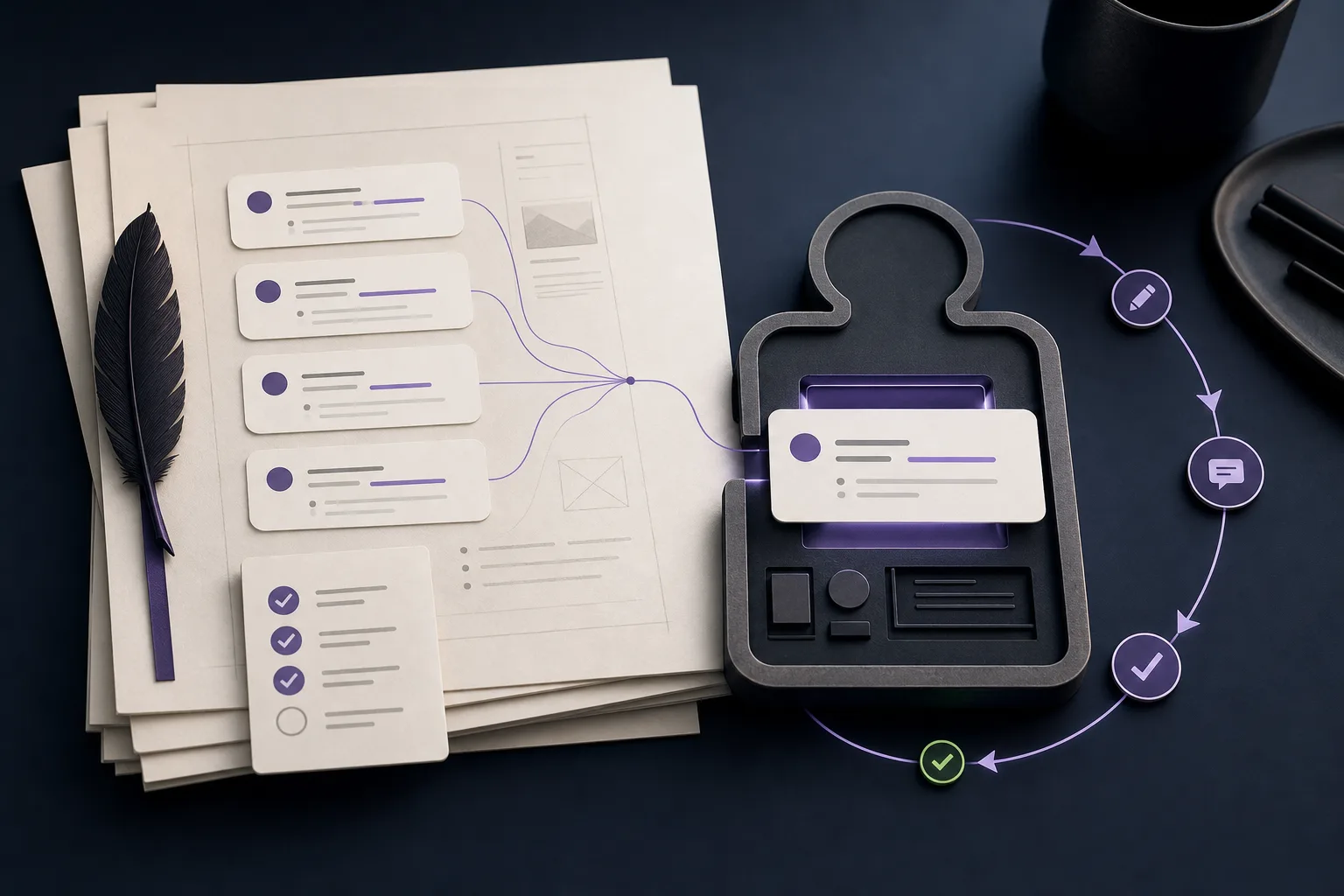
That is why the useful skill is not “ask AI a question.” The useful skill is building a small operating loop around the assistant so it has something real to work from and you still own the final call.
The loop: goal, context, constraints, output
Before asking for help, give the assistant four things:
- Goal: what are we trying to accomplish?
- Context: what does it need to know before answering?
- Constraints: what must it avoid, preserve, or not invent?
- Output: what shape should the answer take?
That sounds obvious until you compare the two versions.
Bad prompt:
Write about AI assistants.
Better prompt:
Goal: three angles.
Reader: builders.
Source: these notes.
Boundary: no private data.
Check: proof gaps.
Output: options.
Human: decisions.
The second prompt does not make the assistant magical. It makes the job bounded. The assistant is no longer wandering through the fog with a flashlight and a suspicious amount of confidence. It has a map, a fence, and a reason to stop at the edge.
Source truth beats vibes
The biggest upgrade is not a clever prompt trick. It is source truth.
If the work matters, do not ask the assistant to build from vibes. Give it the notes, the research, the decision, the transcript, the outline, the requirements, the examples, or the messy pile of real material. Then ask it to help shape that material.
That changes the relationship.
Without source truth, the assistant is tempted to complete the pattern. It has seen a million versions of this kind of thing, so it produces version one-million-and-one. Smooth. Familiar. Dead inside.
With source truth, it has a job: preserve what is real, organize what is messy, expose gaps, and make useful options.
That is why I like source packets. Not as bureaucratic cosplay. As an anti-slop mechanism.
A good source packet says:
- who the work is for;
- what source material is allowed;
- what claims need proof;
- what boundaries must not be crossed;
- what output is being requested;
- what decision still belongs to the human.
That turns the assistant from a vibes machine into a shaped helper. It still needs supervision. It just starts from a better place.
Check the claims that matter
You do not need to fact-check every sentence with the intensity of a courtroom drama. Some work is low stakes. If you ask for ten headline options, the seventh one being mediocre is not a constitutional crisis.
But some claims matter.
Check anything that is factual, current, consequential, legal-ish, medical-ish, financial-ish, privacy-related, safety-related, or likely to be repeated by someone else as truth. Check names, numbers, dates, quotes, policy claims, product behavior, pricing, model capabilities, and anything that would embarrass you if it were wrong.
AI systems can generate convincing mistakes. NIST’s generative AI risk profile talks about information integrity, data protection, provenance, and the difficulty of measuring these systems in real use. UNESCO has been blunt about the public version of the problem: AI can make mistakes that look polished enough to spread. The practical lesson is simple: if the claim matters, make it earn trust.
A useful assistant should help with that too. Ask it to separate:
- claims it can support from the provided source;
- claims that need external checking;
- assumptions it is making;
- decisions it cannot make for you.
If it cannot tell you where confidence came from, do not borrow the confidence.
Privacy is a work habit, not a footnote
The other checkpoint is privacy.
Before pasting something into a public or shared AI tool, ask: would I be comfortable if this text were stored, reviewed, logged, reused for troubleshooting, exposed by a bad setting, or read by someone who was not in the room?
That does not mean every AI tool is unsafe. It means the burden is on you to know the tool, the account settings, the data policy, and the sensitivity of what you are sharing. The FTC has been looking at how AI chatbot companies handle user conversations and personal information. That alone is enough reason not to treat a chat box like a private diary with autocomplete.
Keep private material out unless you have a reason and a safe setup. Redact names. Replace specifics with placeholders. Summarize instead of pasting raw text. Use local or approved tools when the material requires it.
The assistant does not need every detail to help. It needs the right details.
Keep the human checkpoint explicit
The assistant can draft the options. It can make the checklist. It can find the holes. It can suggest the next step.
Then you decide.
That last sentence sounds small, but it is the whole game. If the assistant writes and the human rubber-stamps, judgment has already been outsourced. The human checkpoint needs to be visible in the process:
- What is actually true?
- What belongs in this piece of work?
- What needs proof before it ships?
- What should stay private?
- What is the next action, and who owns it?
The best AI-assisted work I see is not the work where the model sounds smartest. It is the work where the human set the frame, supplied the source truth, checked the dangerous claims, and made the final decision.
The machine helped. The human remained responsible.
A simple way to use assistants better
Use this loop the next time the work matters:
- Name the job.
- Provide the source material.
- State the reader, audience, or user.
- List the boundaries.
- Ask for the output shape.
- Ask it to mark proof gaps.
- Review the result like you still own it, because you do.
That is not anti-AI. It is the opposite. It is how you get more value from the tool without handing it the steering wheel.
AI assistants are useful because they are fast, flexible, and tireless. They are risky for the same reason. Speed makes weak thinking travel farther. Fluency makes bad assumptions harder to spot. Generic answers can look finished before they have earned it.
So use the assistant.
Give it context. Give it constraints. Give it source truth. Make it show its gaps. Keep private material private. Check the claims that matter.
Then make the call yourself.
That is the deal: leverage without surrender. The assistant can help build the workbench. It does not get to become the carpenter.
Sources checked
- NIST AI 600-1, Artificial Intelligence Risk Management Framework: Generative Artificial Intelligence Profile.
- UNESCO, “AI can make mistakes: Why media literacy matters more than ever.”
- Federal Trade Commission, inquiry into AI chatbots acting as companions, including data handling and personal information practices.
Share this article
If this helped, pass it along.