Make Your Work Visible With a Simple Map
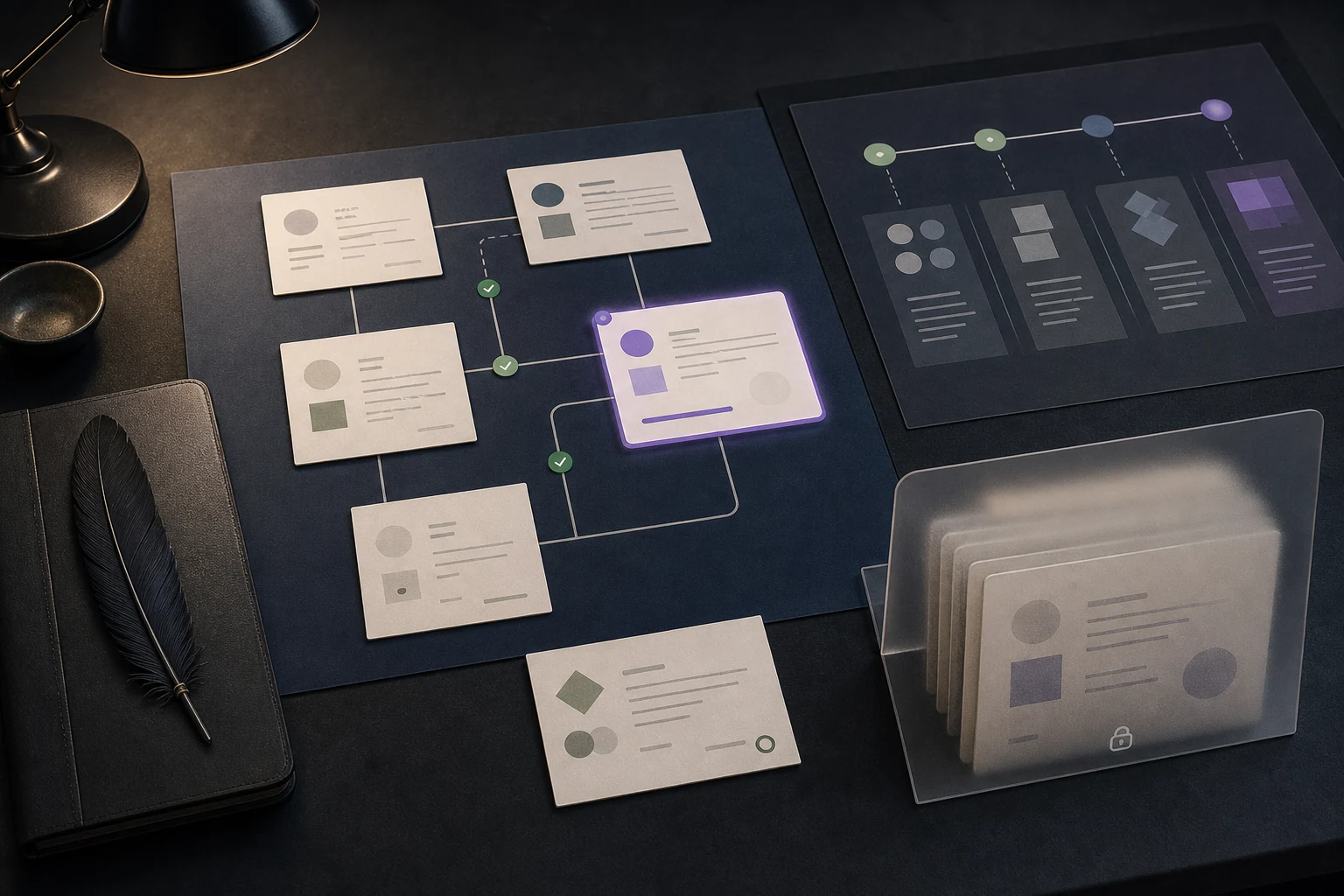
Useful work can be surprisingly hard to trust from the outside.
You may have real projects, real lessons, half-finished experiments, working notes, and a few things that are genuinely ready to show. But if a visitor lands on a blank portfolio claim like “I build AI systems,” they still have to take your word for it.
The opposite mistake is dumping everything in public. That does not build trust either. It turns the reader into your archaeologist. Nobody wants to excavate your folders to figure out what matters.
A small work map is the middle path.
It does not need to explain everything. It just needs to show the shape of the work honestly enough that a reader can orient themselves.
The goal is not to make unfinished work look finished. The goal is to make real work easier to understand.
The Map Is Not The Work
A public work map is a front door, not the house.
It should help someone answer a few simple questions:
- What exists?
- What is active?
- What is proof?
- What is still experimental?
- Where should I go next?
That is enough.
The map does not need every internal note, every task, every abandoned branch, every private tool, or every naming debate that happened along the way. Those things may matter to the builder. They do not automatically matter to the reader.
The reader needs orientation before detail.
Label Maturity Instead Of Hiding It
The scary part is that not everything is done.
Good. Say that.
A useful map can use simple maturity labels:
- Live proof: this exists and can be checked.
- Active foundation: this is being built and already shapes other work.
- Working pattern: this has repeated enough to be useful.
- Experiment: this is being tested, not promised.
- Parked: this is real history, but not current focus.
Labels like these are small, but they do a lot of work. They prevent the polished-showroom problem, where everything looks equally finished. They also prevent the messy-workbench problem, where nothing has a clear status.
Honest labels let a reader trust the map without needing backstage access.
Keep The Private Machinery Private
Visibility is not the same as exposure.
A good map can be public without showing private machinery. You can explain the shape of the work without exposing file paths, internal boards, credentials, family details, client context, raw logs, or operational routing.
The public version should translate the work into reader-useful terms.
Instead of showing every backstage mechanism, show the outcome or the pattern:
- “Projects” instead of raw implementation folders.
- “Workflows” instead of internal handoff mechanics.
- “Skills” instead of every prompt, script, or agent instruction.
- “References” instead of private notes and scratchpads.
- “Experiments” instead of pretending every prototype is a launch.
The private system can stay detailed. The public map should stay legible.
A Simple First Version
If your work feels too complex to explain, start smaller.
Make a map with only four parts:
The work that is active and worth attention.
The things someone can inspect or use.
The repeatable methods, lessons, or systems emerging from the work.
The clearest path for someone who wants to understand more.
That first version is not a brand architecture. It is a trust tool.
You can improve it later when the work changes. In fact, you should. A stale map is worse than no map because it teaches the reader not to trust the signs.
The Reader Test
Before publishing a map, read it like someone who just arrived.
Ask:
- Can I tell what kind of work this is within 30 seconds?
- Can I see which pieces are finished, active, experimental, or parked?
- Can I choose a next path without understanding the whole system?
- Does this make the work more trustworthy, or just more impressive-looking?
- Did anything private leak because it was easier to copy than translate?
If the map fails those questions, do not make it bigger. Make it clearer.
The Point
A work map is not a promise that everything is solved.
It is a way to stop making the reader guess.
If the work is real, show the shape. Label the maturity. Hide the private machinery. Point to the next useful path.
That is often more trustworthy than another polished claim.
Share this article
If this helped, pass it along.