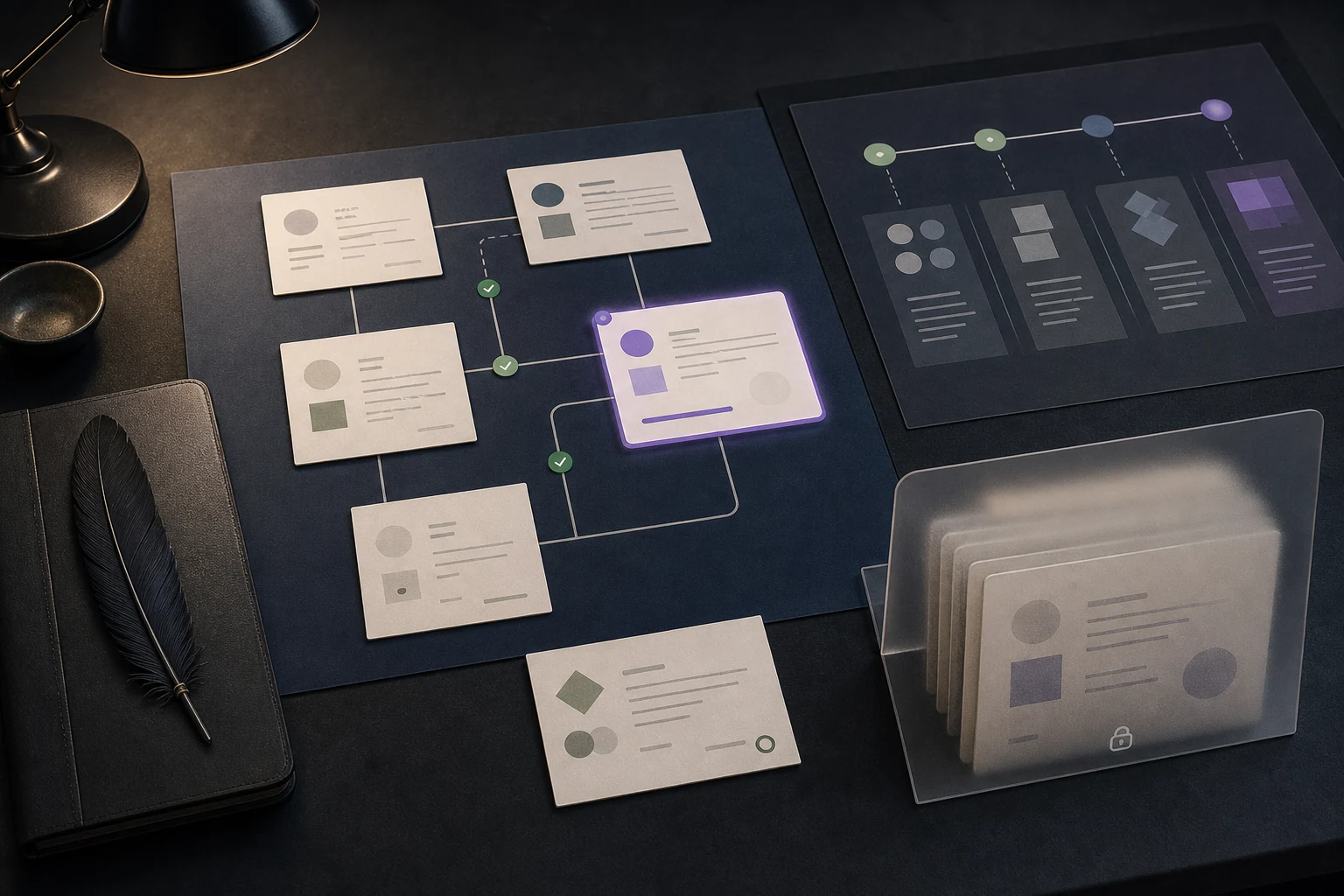
Make Writing Part of the Work

Useful work creates more than a finished result.
It creates decisions. It creates tradeoffs. It creates the small explanations that make a future pass easier: why one route worked, why another one was cut, why a rough edge was left alone until the premise was clearer.
Those details are easy to lose if writing only happens after the work is over. By then the tool may function, the page may render, or the plan may be accepted, but the most useful part is already fading: the judgment that made the result possible.
That is why writing is part of the work. Not decoration. Not a content calendar pretending to be momentum. Writing is how a useful decision becomes reusable.
The useful layer deserves a place to land
A finished thing can hide the path that made it good.
A reader sees the published article, the page, the working script, or the simplified workflow. They do not automatically see what got cut, what changed direction, what risk was avoided, or what rule became clearer because of the pass.
That hidden layer is often the most valuable part of the work.
For a builder, it becomes the next checklist. For a reader, it becomes the reason the piece is worth trusting. For a future collaborator, it shows how the work thinks, not just what it produced.
If the decision was useful enough to change the work, it is probably useful enough to capture somewhere.
That does not mean every scratch note deserves a public page. Most do not. But the important patterns need a place to land before they become vague memory.
Writing turns one solved problem into a reusable one
A homepage cleanup is not only a homepage cleanup.
It might reveal that placeholder pages were being promoted as if they were finished reader paths. That lesson can become a launch check. It can become a note in a workflow. It can become a short article about not letting future plans masquerade as current proof.
The public artifact is not a trophy for having done the work. It is the part that lets the work keep helping.
The same pattern shows up everywhere:
- a decision becomes a reference;
- a repeated route becomes a workflow;
- a useful example becomes an article;
- a recurring review habit becomes a checklist;
- a clear boundary becomes a safer next pass.
The writing is not separate from that loop. It is the loop becoming visible.

A status update is not the same as a useful artifact
A status update says something moved.
A useful artifact explains why the move mattered.
“I changed the page” is motion. “I changed the page because it was asking the reader to trust a future section before there was anything useful behind it” is a decision. The second version can help the next page, the next launch, and the next person trying to understand the work.
That distinction matters because motion is cheap. A project can produce endless updates without producing anything a reader can use.
The useful question is not “what happened?”
The useful question is “what did this make clearer?”
If the answer is strong, the work may have produced more than an output. It may have produced a public artifact.
The public boundary makes the writing stronger
Writing as part of the work does not mean leaking the workshop.
A reader does not need raw task chatter, private paths, coordination details, or every messy note that made the decision possible. They need the translated value:
- what problem showed up;
- what decision mattered;
- what changed;
- what can be reused;
- where to go next.
That translation is not a loss. It is part of the craft.
The public boundary forces the work to shed the scaffolding and keep the signal. It turns “here is what happened inside the process” into “here is the pattern you can recognize in your own work.”
That is why the boundary is not bureaucracy. It is how the page becomes reader-facing instead of maker-facing.
Route the idea to the right shape
Not every useful decision should become an article.
Some ideas are better as short references. Some belong inside a workflow. Some become project notes. Some should stay private. Some are not ready to publish at all because they still depend on a decision, an example, or a clearer reader.
The important habit is routing.
A decision about how to review public pages may belong in a checklist. A lesson from building a reusable helper may belong in a workflow note. A broader principle from several projects may deserve an article. A private implementation detail may deserve no public surface at all.
The stronger the work gets, the more important routing becomes. Otherwise every useful idea gets shoved into one feed until the feed becomes a junk drawer with a nicer font.

The flywheel is real work, not volume
The goal is not to publish more words.
The goal is to make useful work easier to understand, reuse, and improve.
Do real work. Notice the decision it created. Turn that decision into the right artifact. Let the artifact reveal the next gap. Route that gap to the next right place.
That is the flywheel.
It only works when the writing carries real judgment. A weak page does not help just because it exists. A generic article does not become useful because it mentions process. The artifact has to preserve something specific enough that the next reader, builder, or future version of the project can use it.
When it does, the work compounds. One decision becomes a page. One page becomes a reference. One reference makes the next project easier to explain. The effort does not reset to zero every time.
That is the point: writing is part of the work because it helps the work keep working.
Share this article
If this helped, pass it along.