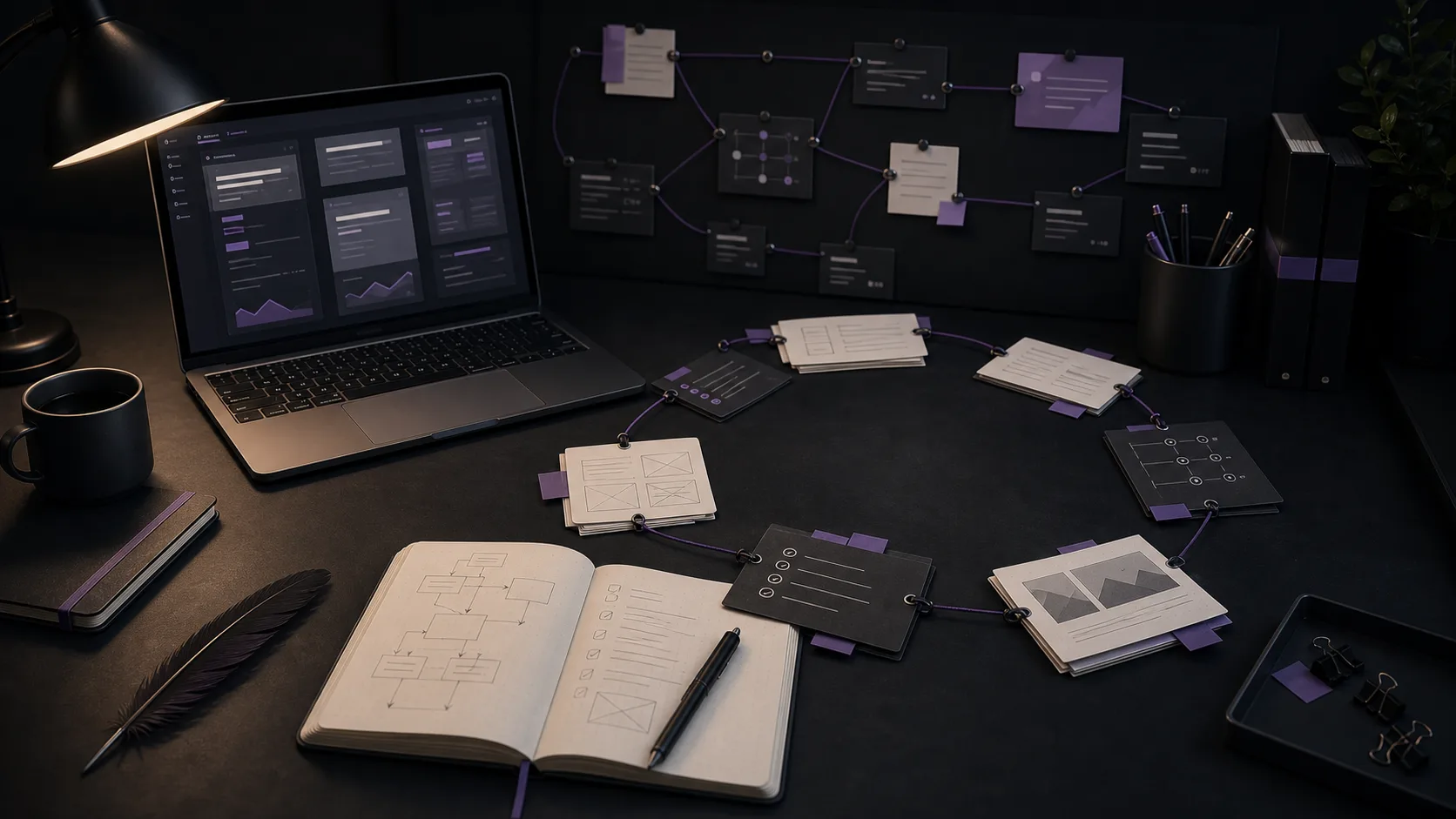
The Content Flywheel Behind The Work

Useful work creates more than a finished thing.
It creates decisions. It creates tradeoffs. It creates the little “that worked because…” moments that are easy to lose if nobody writes them down in a way another person can follow.
That is why writing is part of the work here. Not decoration after the work. Not marketing garnish sprinkled over the top so the page looks busy. Writing is how the useful layer becomes durable.
The Work Is Not Done When The Thing Works
Getting something to work matters. Obviously. A broken tool with a beautiful essay attached to it is still a broken tool, just with better lighting.
But when a project works, there is usually another layer worth saving:
- what changed
- what got cut
- what was harder than expected
- what became simpler
- what should be reused
- what should never be repeated unless everyone has had coffee and signed a waiver
If that layer only lives in memory, it disappears fast. If it stays buried in private working material, it may help the next task, but it does not help the reader who is trying to understand the work from the outside.
A public article, knowledge-base page, workflow, skill, or project writeup is how that useful layer becomes findable.
For example, a homepage cleanup is not only a homepage cleanup. It may reveal a site rule: do not promote placeholder pages as if they are finished reader paths. That rule can become a launch check, a knowledge-base note, or a future workflow step.

Writing Is Not A Status Update
A status update says something moved.
A useful page explains why it mattered.
That difference is the whole game. “I changed the homepage” is movement. “I changed the homepage because the old section was surfacing future content as if it already existed” is a decision. That second version can become a pattern: do not make public discovery depend on placeholder pages.
That pattern can help more than one page. It can become a workflow check, a KB reference, a launch rule, or a future article. The writing turns one solved problem into a reusable piece of the system.
The Flywheel
The flywheel is simple:
- Do real work.
- Notice the useful decision, pattern, or question it created.
- Turn that into the right public page.
- Let that page reveal the next useful gap.
- Route the new idea to the right place.
The point is not to publish for volume. Volume is easy. A person can make an infinite pile of words and still have nothing worth reading. The point is to make each public piece improve the next pass.
An article might reveal that a short reference belongs in the Knowledge Base. A project page might show that a workflow should be written down. A workflow might expose a reusable skill. A skill might create a better launch checklist.
That is the useful loop.
Frederick Douglass put the deeper point with more force:
“If there is no struggle, there is no progress.”
Frederick Douglass
That is exactly why the flywheel matters.
A bicycle still requires effort. You still push the pedals. You still deal with the hill, the distance, the heat, and the part where your legs ask who approved this plan. But the flywheel and the gearing change what the effort does. The same human work carries farther than walking because the machine preserves momentum.
That is the content version of the idea. Writing does not remove the struggle from the work. It keeps the useful part of the struggle moving. A decision from one project becomes the example for the next article. That article becomes a reference for the next workflow. The workflow makes the next project easier to explain. The effort compounds instead of resetting to zero every time.
Not Every Idea Belongs In The Same Place
A flywheel only works if ideas are routed instead of hoarded.
Some ideas belong on RomeoRaven because they explain the personal work map: projects, systems, workflows, articles, skills, and public thinking around the build.
Some ideas may eventually belong on Ravonyx because they are more business facing: services, offers, consulting language, or customer acquisition. Those ideas can be born here, but they should not turn RomeoRaven into a sales page wearing a raven mask.
Some ideas belong in the shared system. If a site rule, checklist, reusable skill, or workflow improves because of the work, that improvement should live where future sites can use it.
The right destination matters. Otherwise every useful idea gets shoved into one folder until the folder becomes a junk drawer with confidence.
The clean version is simple: if an idea helps explain the work, it may belong here. If it sells the work, it may belong on a business-facing site. If it improves the repeatable process, it may belong in the shared system. Same idea, different destination.

The Public Boundary Makes The Writing Better
Public-safe does not mean vague.
It means the page has to translate private working material into the useful pattern. A reader does not need private hostnames, raw coordination notes, or behind-the-scenes task mechanics. They need the point:
- what problem showed up
- what decision mattered
- what changed
- what can be reused
- where to go next
That translation usually makes the writing stronger. It strips away the parts that only matter to the people inside the work and leaves the parts that can stand on their own.
That is why the public boundary review and the idea-to-publish workflow matter. They are not bureaucracy. They are how the site keeps the useful signal and leaves the private scaffolding where it belongs.
What This Site Should Do
RomeoRaven should grow from the work, not from a content calendar pretending to be a personality.
When a project produces a useful lesson, it can become an article. When an article needs a stable definition, that can become a KB page. When the same path repeats, it can become a workflow. When the behavior becomes reusable, it can become a skill. When the pattern proves itself in public work, it can show up as project proof.
That is the promise: useful pieces, connected clearly, built from real work.
Not every thought deserves a page. The ones that do should make the work easier to understand, easier to follow, and easier to build from.
Related Paths
Share this article
If this helped, pass it along.